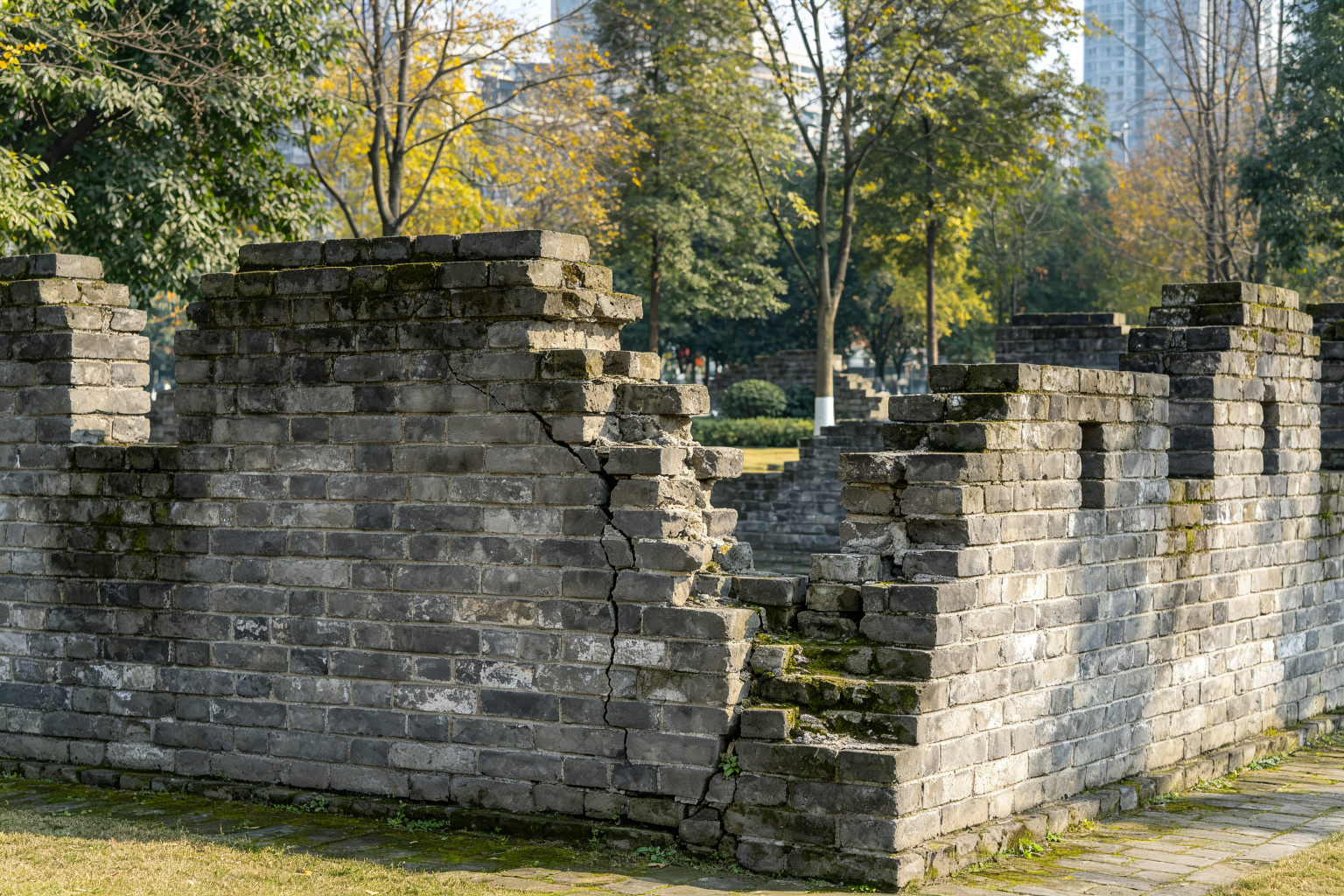
Every old Chinese city was once circled by a high, crenellated wall and a moat. Chengdu was no exception: founded as a Zhou-period town, rebuilt in brick under the Ming, expanded under the Qing, and finally torn open in the 20th century to let the modern city breathe. Today almost none of that wall survives. What remains are a handful of weathered brick fragments, quietly fenced off in city parks, marked with small plaques. They are the remnants of the ancient Chengdu city wall.
What happened to the walls
- From the Qin and Han conquest onward, Chengdu's wall defined a square inner city, rebuilt in each dynasty.
- The great Ming and Qing walls were 10 meters high, with four gates and a deep moat; the rivers that fed that moat still run through the city.
- In the 20th century, as roads and trams arrived, the walls were demolished gate by gate. Stone was reused, brick was carted away, and by the 1950s only fragments were left.
How to read a fragment
Look closely at the surviving brick. You will see uneven courses, repaired patches, gray and blackened bricks, and the marks of centuries of rain and soot. One well-known preserved section sits beside a small park not far from the old city center; another fragment survives near the older neighborhoods to the north. They are unglamorous, but they are ground zero for imagining the walled city of old Chengdu.
What surrounds them today
These fragments are not isolated ruins. They sit inside the living city: beside a tree-lined pedestrian path, across the street from a tea house, where locals walk and children play. Standing by a 400-year-old wall while skyscrapers rise behind it is the fastest way to feel Chengdu's layers of time.
How to read a ruined wall
Cities usually celebrate their walls by rebuilding them. Chengdu is unusual in that it left a stretch of the original brickwork standing, cracked and half-buried, as a quiet record of how the city changed. Read the fragment not as a monument but as a layer: newer bricks at the top, older at the base, patches where later generations repaired a breach. Standing beside it, you hold four centuries of urban growth in a single glance.
The remnant sits inside a small free park, so come with no expectation of crowds. Read the short plaques nearby, then walk a little along the modern ring road to picture where the old fortifications once ran. This is a stop for history-minded travelers rather than photo hunters; give it twenty minutes and pair it with lunch in the old neighborhood. It rewards patience more than spectacle.
Practical information
- Where to look: preserved remnants of the Ming-Qing city wall survive in small urban parks near the historic city center; ask a local guide for the closest marked section
- Transport: reachable on foot or by Metro Lines 2/4/4 around the city center; pair the visit with Kuanzhai Alleys or People's Park
- Cost: free to view
- Tips: They are fragments, not a grand castle. Come with imagination, and read the plaque. The real point is not the brick but the fact that a whole walled city once stood here.
A weathered brick in a city park is all that remains of Chengdu's defenses. It is enough, if you know how to look, to rebuild the whole old city in your head.