Every old city has a river it calls mother. Chengdu's is the Jinjiang (锦江, "Brocade River"), actually two clean mountain streams, the Fu River and the Nan River, that meet in the city and water the plain. It does not look grand, but its name is woven into Chinese literature: this is the river where Han workers washed newly dyed brocade to set its colors, and where the Tang poet Du Fu, the courtesan-poet Xue Tao, and endless scholars wrote their lines.
Why it is called the Brocade River
Under the Han dynasty, Chengdu's official weavers made Shu brocade. To fix the dyes and make the silk glow, they washed the fresh cloth in the river's clean running water. That labor gave the river its name — the Brocade River — and gave Chengdu its ancient title, the "City of the Brocade Officer." Every time you cross the Jinjiang today, you cross the water that once made Chengdu rich.
The riverside landmarks
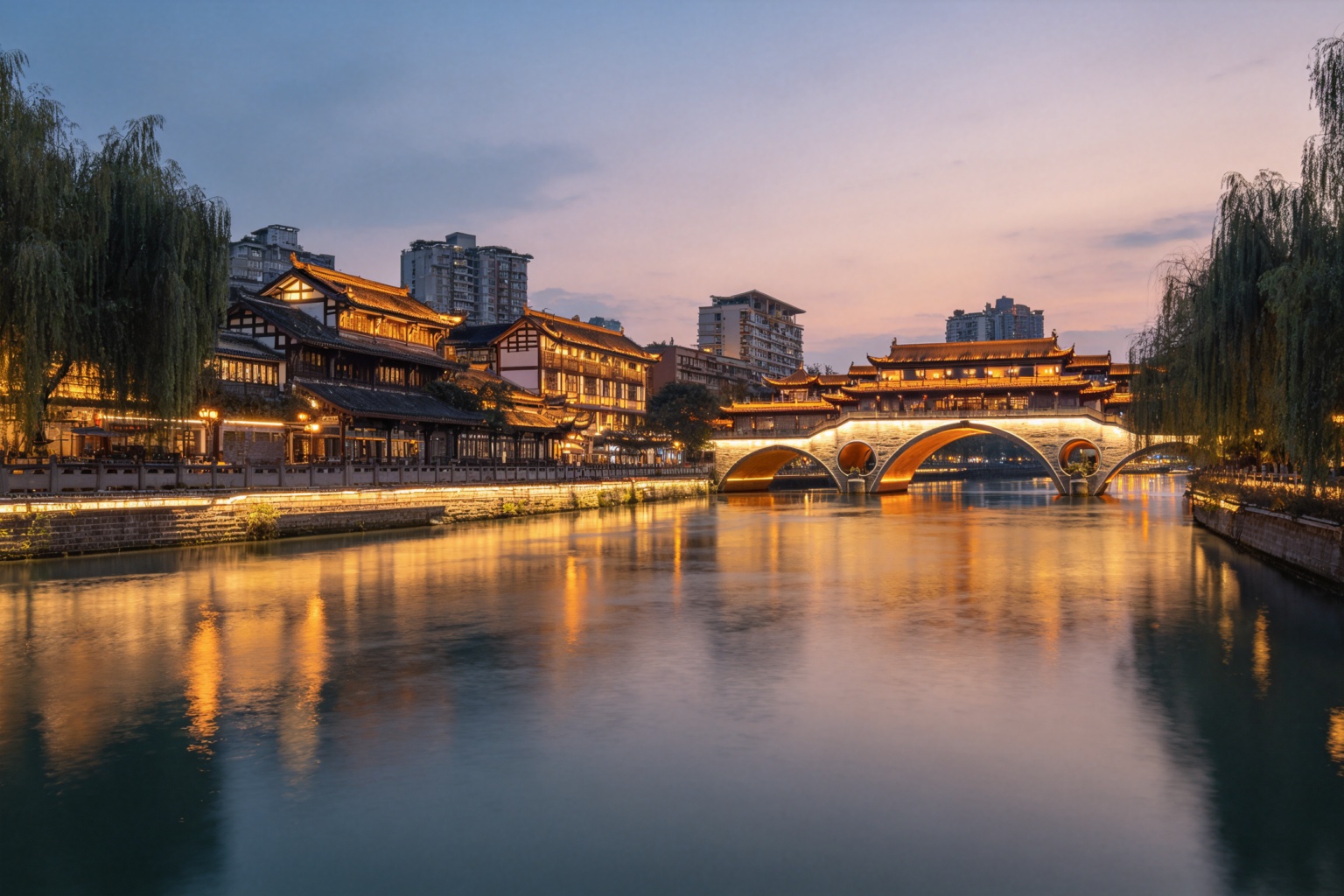
- Anshun Corridor Bridge (安顺廊桥), a red-lit covered arch bridge that is the postcard view of Chengdu at night.
- Hejiang Pavilion (合江亭), the historic spot where the Fu and Nan rivers meet.
- Wangjianglou Park (望江楼公园), a bamboo grove built to honor Xue Tao, the Tang poetess who lived by the river and made her own flower-dyed paper.
What to do
Walk the riverbank in the early evening. Locals dance, fly kites, fish and play mahjong under the willows. Take a short night cruise from the Anshun Bridge if you like lit-up views. The best single stretch is between Hejiang Pavilion and Wangjiang Tower, with tea houses and old-style bridges along the way.
Why the river named the city
Chengdu would not be itself without the Jinjiang. Two thousand years ago, artisans dyed Shu brocade in its currents, and the city took the nickname Brocade City from the cloth that floated here. Poems, farewells, lovers' meetings and boat races have all unfolded along these banks, so walking the river today is walking through the collective memory of the civilization that grew up on its water.
The finest way to experience it is on foot at dusk, crossing the Anshun Bridge and drifting slowly past the lantern-lit teahouses. Renting a small boat in summer lets you see the opposite bank the way poets did. Time a weekend visit for the evening light rather than midday, and stop for a bowl of tea where the water is calm. The river is the one free attraction that never disappoints.
Practical information
- Where to start: Hejiang Pavilion / Anshun Bridge area, Jinjiang District (锦江区), central Chengdu
- Transport: Metro Line 2 to Chunxi Road or Dongmen Bridge, then walk to the river; Wangjianglou Park is near Metro Line 6
- Opening hours: the riverside is free and open 24 hours; Wangjianglou Park 6:00-21:00
- Cost: walking the bank is free; a short night boat cruise about 80-120 RMB; Wangjianglou park free or a small garden fee
- Tips: Go at dusk, when the lanterns switch on. Bring a jacket by the water. Pair the walk with a dinner in the Jiuliti or Anshun Bridge neighborhood.
Chengdu's brocade, its poetry and its famous women all flow through the Jinjiang. Walk it at sunset, and the city starts to make sense.