In the year 759, a middle-aged civil servant arrived in Chengdu with his family, fleeing a civil war that had shattered the Tang dynasty. He was hungry, sick and nearly unknown. Within a few years he would be regarded by posterity as the greatest poet China ever produced. His name was Du Fu (杜甫, 712-770), and the thatched hut he built on the Chengdu plain is today the Du Fu Thatched Cottage (杜甫草堂, Dùfǔ Cǎotáng).
Why Du Fu matters
Du Fu lived through the catastrophic An Lushan rebellion, and his poems became a mirror of ordinary people's suffering. Where Li Bai soared in fantasy, Du Fu wrote about war, flood, poverty and the joy of a roof over his head. His 1,400 surviving poems cover history, landscape, friendship and wine in such perfect form that later critics called him the "Poet-Historian" and his work a "poetic chronicle." Chinese schoolchildren still recite lines he wrote here by the Jinjiang River.
The four years in Chengdu
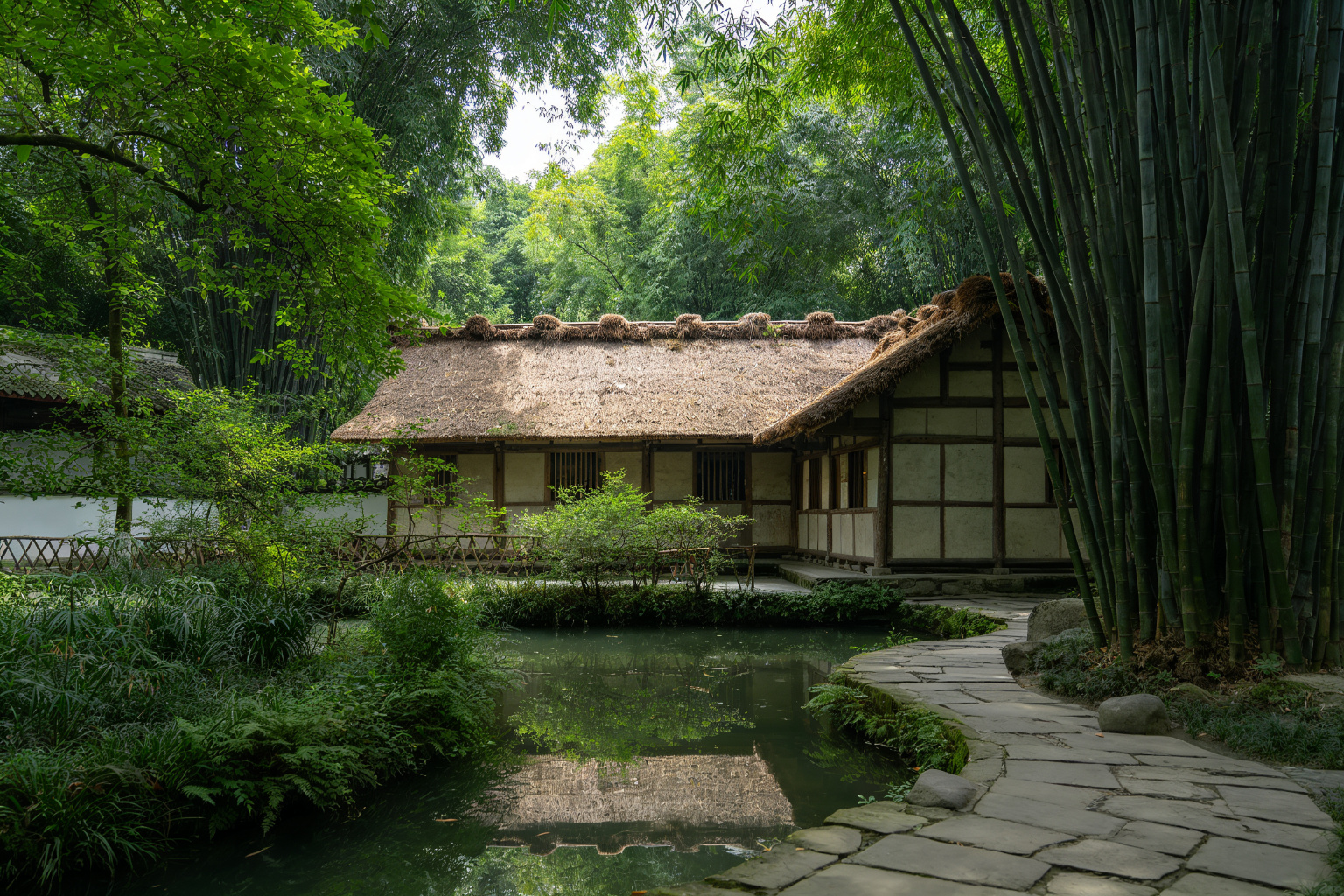
With the help of friends, Du Fu built a simple thatched cottage by the stream, farmed vegetables, and was visited by local scholars and his great friend, the poet Pei Di. Some of his most loved poems about spring rain, moonlight, autumn bamboo and the river come from these years. The original hut is long gone; today's garden is a Ming and Qing memorial complex built to honor a man who could not afford to keep his own roof.
What to see
- The restored Thatched Cottage itself, set by a lotus pond and bamboo groves.
- Flower Path and the thatched gate, where a poem by Mao Zedong is inscribed.
- A museum of Du Fu editions and a hall displaying the calligraphy of his poems by famous hands.
Why a hut matters
The thatched cottage you see is a reconstruction, but the ground beneath it is real. Du Fu lived here for less than four years, yet those years produced some of the poems that define the Chinese poetic voice: poems about war, hunger, the moon over his old home, and a storm that tore the roof off his hut. Chinese children memorize these lines at school, so walking the garden today is less a visit to a museum than a pilgrimage to words every educated Chinese person already carries in their head.
Come in spring, when the bamboo sways and the cherry trees bloom, and spend an hour before the memorial hall. Bring a translation of Du Fu if you can; standing in the actual garden where he wrote makes even the simplest lines land differently. The site is large and restful, so do not rush. Nearby, the narrow lanes of the old west district offer cheap noodles that Du Fu might have recognized.
Practical information
- Address: No. 38 Qinghua Road, Qingyang District (青羊区青华路38号), west Chengdu
- Transport: Metro Line 4 to Caotang North Road (草堂北路站), then a short walk; next door to the Shu Brocade and Embroidery Museum
- Opening hours: 9:00-18:00; ticket office closes around 17:00
- Ticket: about 50 RMB
- Tips: Come in spring, when bamboo and blossom are at their best. Even without reading classical Chinese, the garden is peaceful and moving. Pair it with the brocade museum for a slow literary morning.
Du Fu left Chengdu poorer than he arrived. The world, however, has been reading him ever since.