If you know even a little about Chinese culture, you know the names: Liu Bei, Guan Yu, Zhang Fei, Zhuge Liang. They are the heroes of the Three Kingdoms period (220-280 CE), and Chengdu was the capital of their kingdom, Shu Han. Eighteen hundred years later, the memory of these men still shapes how Chinese people talk about loyalty, strategy and friendship — and it all centers on the Wuhou Shrine (武侯祠, Wǔhóu Cí).
What you are actually visiting
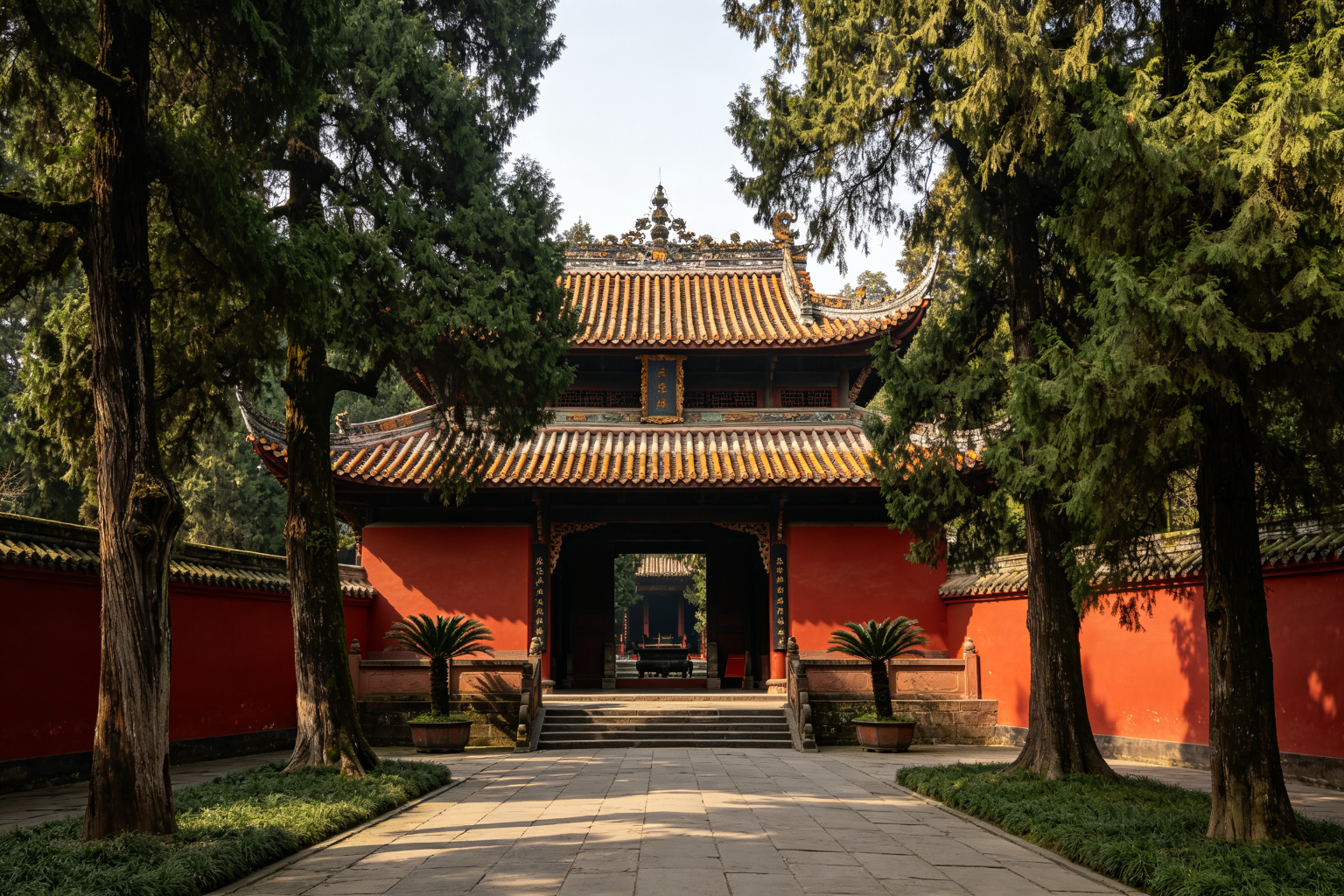
Wuhou Shrine is an unusual combination: a temple to the brilliant strategist Zhuge Liang, merged over the centuries with the tomb of his king, Liu Bei (the Hui Imperial Mausoleum, 惠陵). A red-walled path lined with cypresses connects halls, stone stelae, and halls filled with statues of the Shu heroes. The most photographed spot is the red wall bamboo lane, where sunlight strips through tall bamboo onto vermilion walls.
Why Zhuge Liang still matters
- He is the cultural ideal of the loyal, selfless and brilliant adviser: his "Memorial on Dispatching the Troops" is still memorized by Chinese schoolchildren.
- His name is a byword for clever planning, the origin of the modern Chinese phrase for "go with a plan."
- Romanticized in the 14th-century novel Romance of the Three Kingdoms, his story is known to every speaker of Chinese, from Beijing to Singapore.
Next door: Jinli Ancient Street
Behind the shrine lies Jinli (锦里), a restored Qing-style street of snacks, sugar art, paper masks and tea houses. It is commercial, but atmospheric at dusk when the lanterns come on. Come for the temple by day, then graze your way through Jinli in the evening.
Why Zhuge Liang is still worshipped here
Most heroes of the Three Kingdoms era are remembered as warlords or poets. Zhuge Liang is remembered as something rarer: the perfect minister. In a culture that still values loyalty and integrity above almost everything, the temple at Wuhou is less a memorial to a general than a shrine to an ideal of public service. Walk the halls slowly and read the steles; generations of visitors have come here to measure themselves against the standard he set.
The temple is best visited in the early morning, before the tour groups. Combine it with the old Jinli street right outside the gate, but eat your meal in the surrounding alleys rather than on the tourist lane. If you read only one story, make it the biographical stele: it tells how a man who began as a humble hermit became the most trusted strategist of his age. The atmosphere is quieter and more reflective than most visitors expect.
Practical information
- Address: No. 231 Wuhouci Avenue, Wuhou District (武侯区武侯祠大街231号)
- Transport: Metro Line 3 to Gaoshengqiao Station (高升桥站), then a 10-minute walk through the park
- Opening hours: 8:00-20:00 in summer, closing earlier in winter; the park area stays open late
- Ticket: about 50 RMB; Jinli Street itself is free
- Tips: Buy a guidebook or audio guide, because the statues mean little without the story. Go early to beat the tour groups. Allow 2 hours at the shrine plus an hour for Jinli.
Standing before Zhuge Liang's hall, surrounded by cypress shade, you see why a politician who died 1,700 years ago is still called "marquis" with respect.