Long before the city grew into a metropolis, Chengdu was famous for one luxury: Shu brocade (蜀锦, Shǔjǐn), the gold-and-colored silk that ancient China considered the equal of silk from Suzhou and Nanjing. So central was this fabric that the Han dynasty set up an official "Brocade Officer" (锦官) to manage it, and Chengdu's oldest nickname became Jinguan Cheng, the "City of the Brocade Officer" — later shortened to the romantic "Hibiscus City" that still appears in its poetry.
Brocade versus embroidery
- Shu brocade is woven: patterns are built into the fabric on looms as it is made, traditionally on large wooden drawlooms. Colors are rich, the reverse is nearly as fine as the front, and the cloth has a subtle, heavy silk luster.
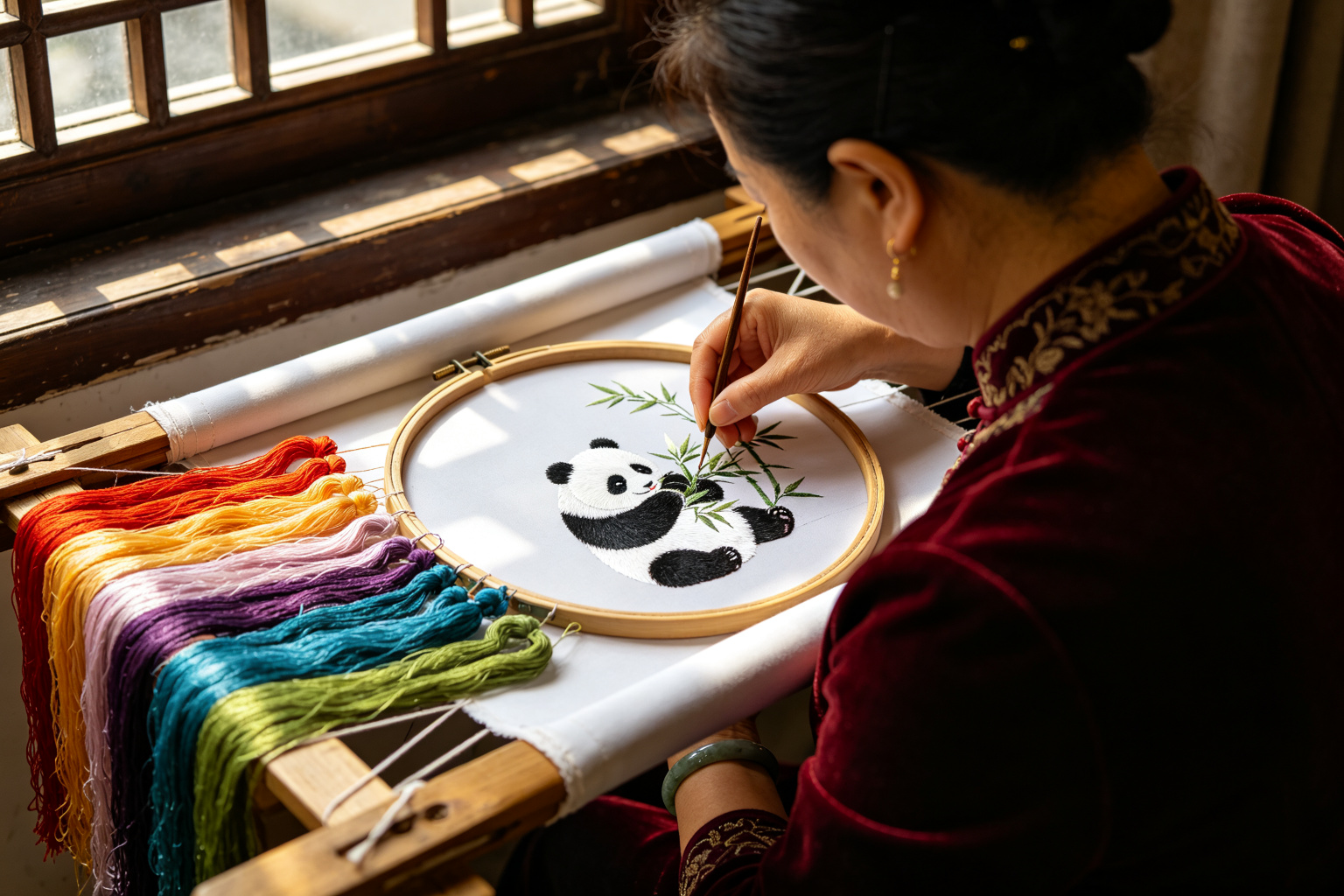
- Shu embroidery (蜀绣, Shǔxiù) is stitched: motifs are sewn onto a plain silk ground with a needle and silk thread. It is one of China's four great styles of embroidery, famous for lifelike fish, pandas, landscapes and a single thread split into as many as 48 strands.
How to watch it being made
At the Chengdu Shu Brocade and Embroidery Museum, working craftspeople still operate antique wooden looms. You can watch a weaver tie a pattern by hand on a 19th-century drawloom and see an embroiderer's needle fly across silk. The museum also shows the dyeing process and sells genuine (if not cheap) pieces. A brocade scarf or a small framed embroidery of a panda is among the most authentic souvenirs in town.
The river that named a city
Because dyed brocade was washed in the local river to set its colors, that waterway became the Jinjiang, the "Brocade River." Today you can walk its banks at dusk and still sense why this cloth made Chengdu rich.
Why the word brocade is loaded
The Chinese word for Chengdu, and even the word for its river, come from this cloth. Shu brocade was so valued two thousand years ago that the Han dynasty set up an official weaving bureau here, and city officials were paid partly in bolts of it. To wear Shu brocade was to signal rank, wealth and taste across the whole of imperial China. Understanding this turns a quiet museum hall into the story of how a single luxury fabric shaped a city's identity.
When you watch a loom, slow down. Each thread is dyed before weaving, and patterns build up color by color rather than being printed on top. Ask the weaver about the difference between brocade, where the pattern is woven into the structure, and embroidery, where it is stitched onto an existing cloth. A scarf or small pouch makes a lasting souvenir far more meaningful than a mass-produced keychain.
Practical information
- Address: Chengdu Shu Brocade and Embroidery Museum, near Caotang East Road, Qingyang District, close to Du Fu Thatched Cottage
- Transport: Metro Line 4 to Caotang North Road, then a short taxi; combine with Du Fu Cottage in one morning
- Opening hours: roughly 9:00-17:30; the workshop floor closes a little earlier
- Ticket: the museum is often free; a small fee may apply for the working loom hall
- Tips: Ask to see the back of an embroidery piece to judge quality. Real handwork is pricey; if a "hand-embroidered" panda costs 30 RMB, it is printed. Bargaining is not expected in the museum shop.
Two millennia after the Han "Brocade Officer," Chengdu still weaves silk the slow, patient way — a thread at a time.