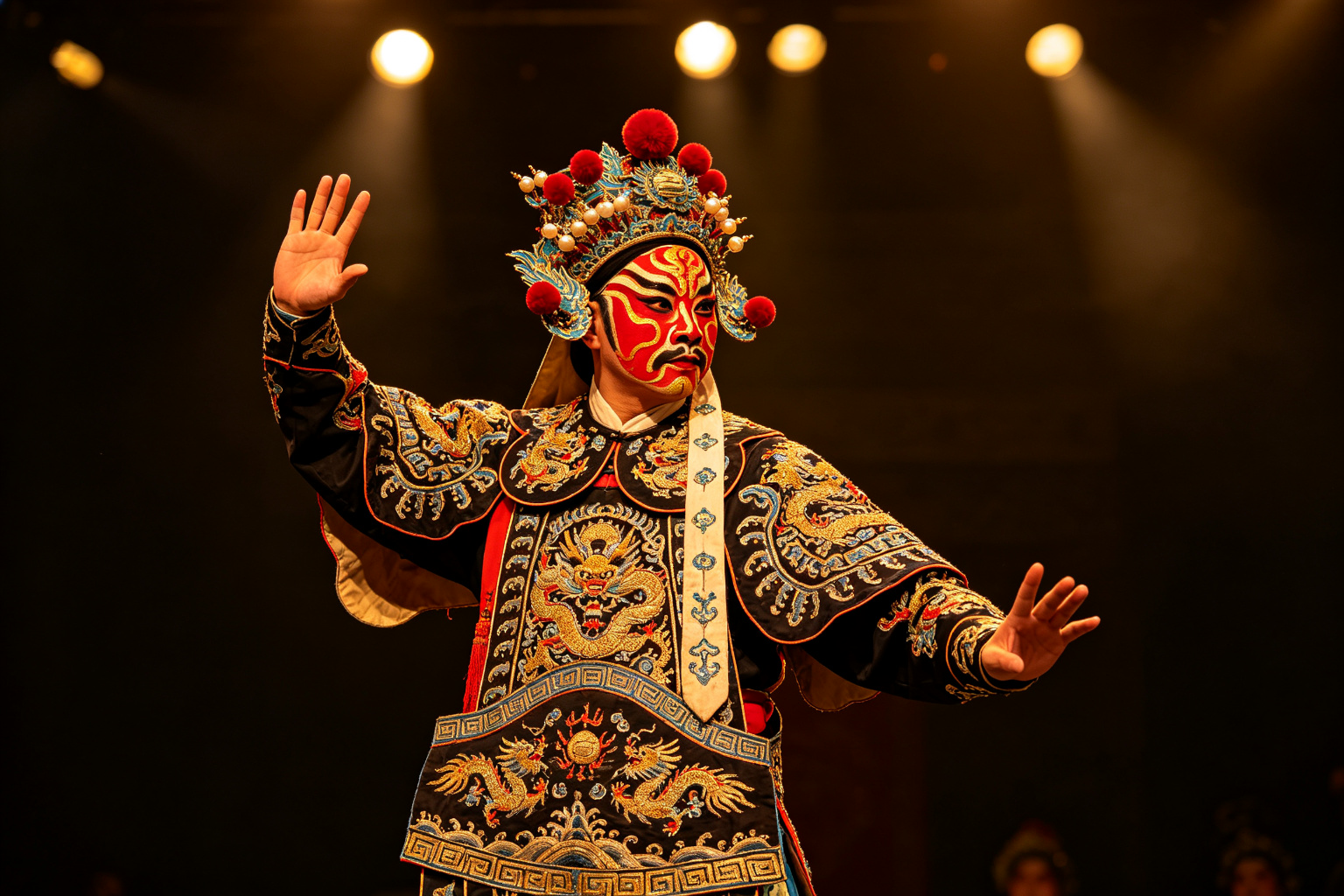
If there is one night out that says "Chengdu", it is a night at the Sichuan opera (川剧, Chuānjù). Born in Sichuan's mix of local tunes, folk arts and regional speech, this is one of China's great regional operas, and the city where it still lives. Foreign visitors come for one reason above all: face-changing (变脸, biànliǎn), the legendary trick in which a performer spins, throws a sleeve, and the painted face on his mask instantly becomes a completely different character.
What actually happens on stage
Sichuan opera combines sung arias, spoken dialogue, acrobatics, comedy and dazzling technical feats. Alongside face-changing you may see fire-spitting (吐火, tǔhuǒ), where an actor breathes a sheet of flame; tightrope walking; and slapstick comedy that lands even when you understand no Chinese. Face-changing works through a stack of thin, individually painted silk masks hidden behind the actor's costume, ripped away in a fraction of a second by trained hand movements and breath. The best performers change ten masks in minutes, ending with a blank white face.
Why it is worth watching even if you speak no Chinese
- It is visual: masks, fire, costume and movement tell the story without a word of translation.
- The tourist-oriented shows are designed for international audiences, with short skits, captions and no long, slow arias.
- It is a living, 300-year-old art form, not a theme-park imitation.
Where to see it
The classic evening is Shufeng Yayun (蜀风雅韵), a restored Qing-style theater near Qingyang Palace, where you can also have your ears cleaned, taste tea and watch Sichuan puppetry and hand-shadow show before the main program. Another favorite is the old Jinjiang Theater (锦江剧场) by the city center. Dinner-and-show packages are widely sold online.
How to choose a show
Not every face-changing performance is equal. Tourist trap stages rush the trick in ninety seconds and pad the night with loud acrobatics; the better houses run two hours of opera, comedy skits and puppetry, with face-changing as one highlight among many. Look for a troupe that performs the classic excerpts rather than a medley, and sit no farther than the fifth row, because the trick depends on a flick of the hand and a flash of cloth you must catch in motion.
Arrive early to watch the makeup and costumes being prepared, and do not photograph during the fastest changes; flashes spoil the timing and annoy the cast. A small tip to the ushers at the door often buys a clearer seat. Pair the evening with hotpot nearby, and if you follow the story at all, the repeated moral themes—loyalty, wit, loyalty to a just cause—are easy to grasp even without subtitles.
Practical information
- Venue (Shufeng Yayun): near Qingyang Palace, Huanhuaxi area, Qingyang District; Metro Line 2/4 to Tonghuilin then taxi
- Show times: usually 20:00 evening shows, about 90-100 minutes; book seats the day before
- Ticket: about 150-380 RMB depending on seat and package; VIP seats include tea and snacks
- Tips: Book online in advance. Arrive early to experience the tea-house atmosphere. Do not try to photograph backstage, and remember: the trick is done at the speed of a blink. If you blink, you will miss it.
A night of Sichuan opera is the fastest way to laugh, gasp and leave with a memory of Chengdu that no museum shelf can hold.