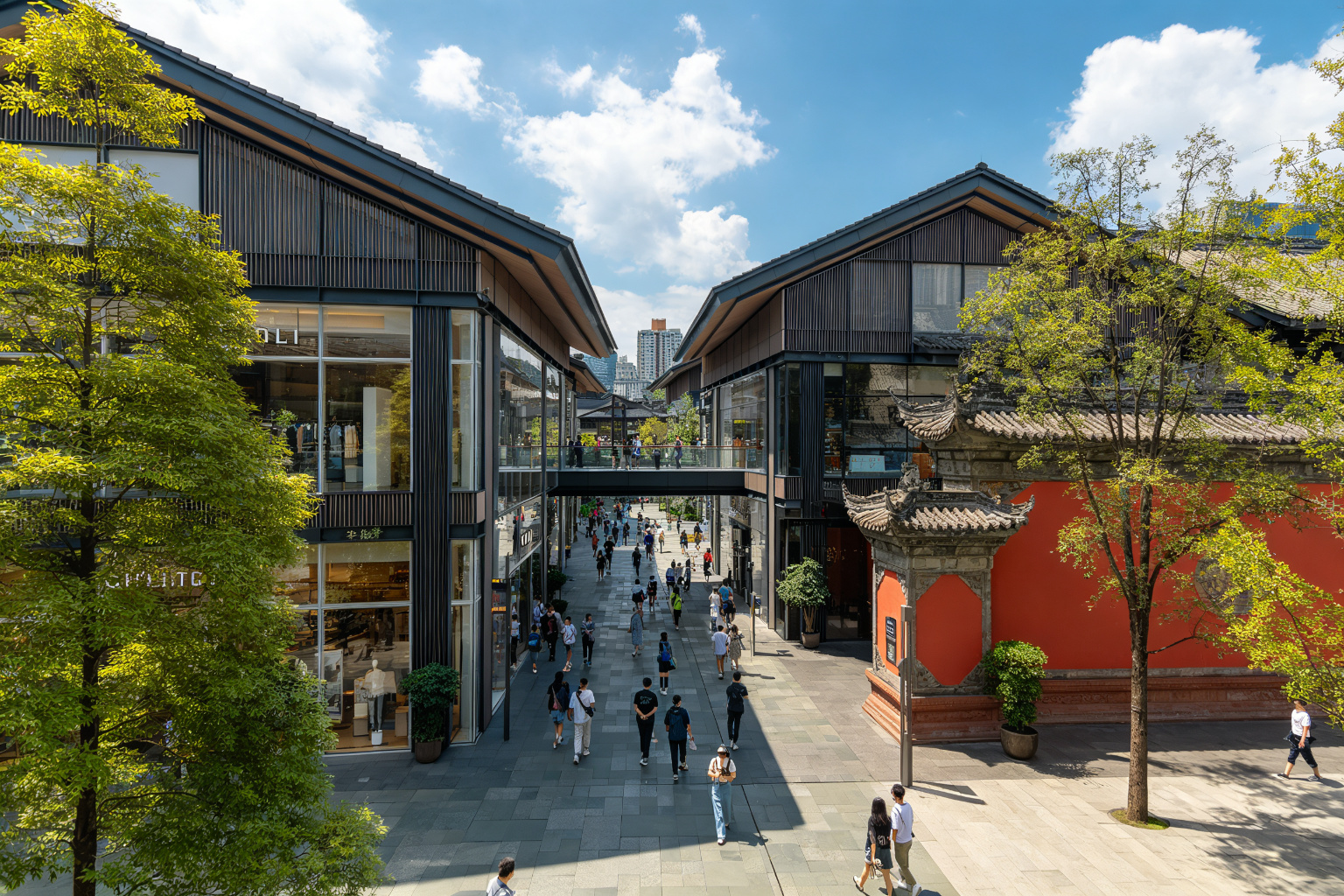
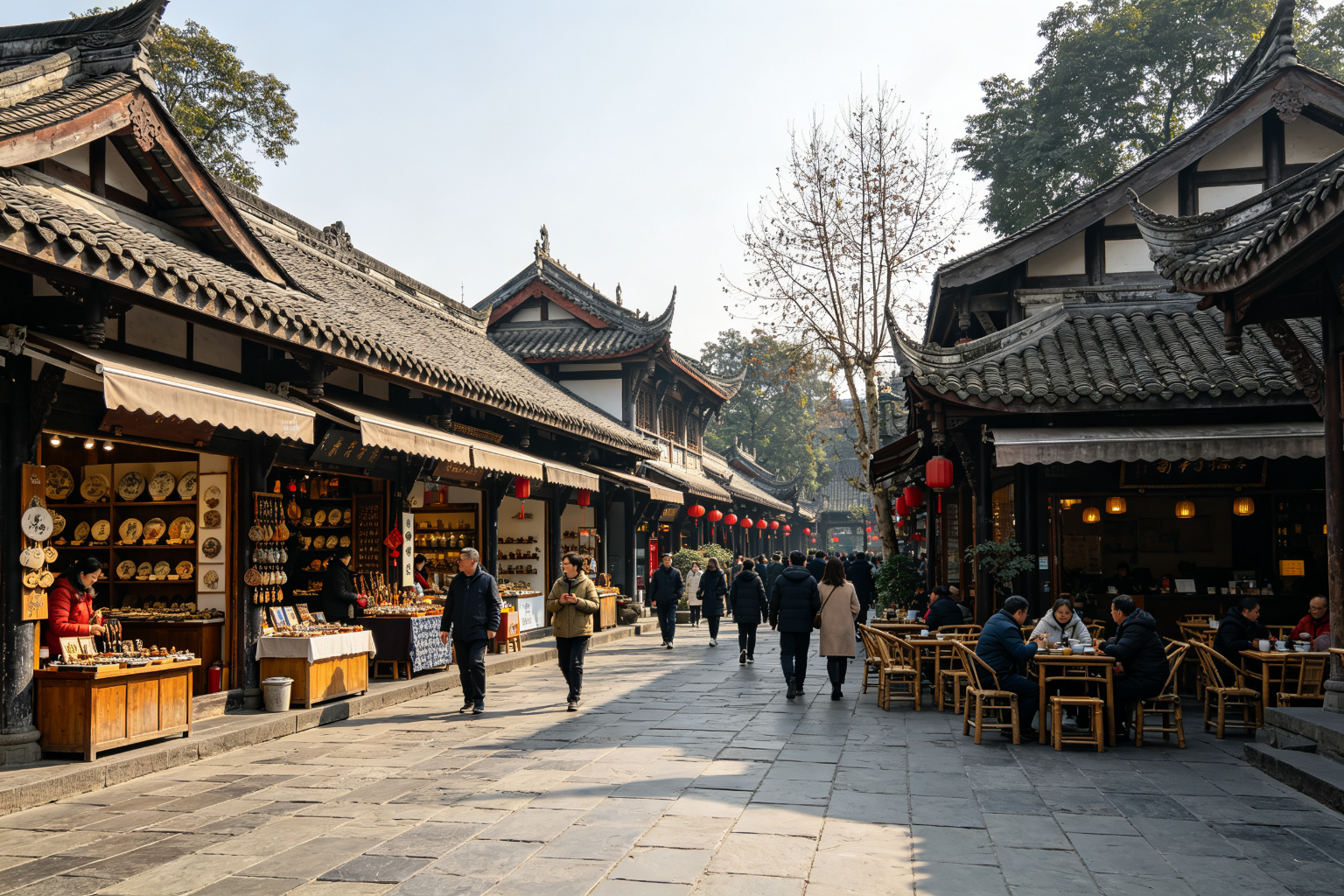
The area around Wuhou Shrine (武侯祠, Wǔhóu Cí) and the adjacent Jinli Street (锦里, Jǐnlǐ) is Chengdu's most concentrated heritage-shopping quarter. Unlike the modern malls downtown, this district is built for slow wandering: flagstone lanes, grey-brick courtyard houses, red lanterns, and shop after shop selling handicrafts that reference three millennia of Sichuan culture. It is the single best place in Chengdu to buy a genuinely local souvenir, watch an artisan at work, and understand what the city's traditional craft economy actually looked like.
Wuhou Shrine itself commemorates Zhuge Liang, the legendary strategist of the Three Kingdoms period, and the surrounding lanes grew up over centuries as a market for devotees and pilgrims. After the 2008 renovation, the area was re-planned as a heritage-style commercial block with strict height and material rules: no neon, no plastic signage, no modern storefronts that break the illusion of an old Sichuan town. The result is a polished but convincing historical shopping street where every shop sells something hand-made.
What to buy
- Shu embroidery (蜀绣, Shǔxiù): one of China's four great embroidery traditions. Small framed pieces start around ¥150; a hand-stitched silk screen of a panda can run ¥1,500–5,000.
- Sichuan face-opera masks (川剧脸谱, Chuānjù liǎnpǔ): hand-painted wooden masks, the classic red Guan Gong or the painted Sichuan opera clown.
- Bamboo crafts: folded fans, lanterns, bamboo weaving boxes and the famous Sichuan bamboo tea scoop.
- Paper-cuts and woodblock prints (剪纸 jiǎnzhǐ): traditional New Year motifs, framed to ¥60–200.
- Tea: Mengding Ganlu green tea, Biluochun and Jasmine tea sold in hand-tied bamboo baskets.
Several workshops let you watch artisans at work: an embroiderer at a wooden frame, a bamboo weaver at a loom, a calligrapher grinding ink. Watching is free; ask politely before taking close-up photos.
Practical Information
- Address: Wuhouci Street, Wuhou District (武侯区武侯祠大街), around the Wuhou Shrine east gate.
- Transport: Metro Line 3 to Gaoshengqiao Station, exit B, then a 10-minute walk south; or bus 57, 82, 334 directly to Wuhouci stop.
- Opening Hours: most shops 09:00–21:30; Wuhou Shrine itself 08:00–20:00 (ticket ¥50).
- Price level: budget to mid; souvenirs ¥30–500, embroidery pieces ¥150–5,000.
- Payment: WeChat Pay and Alipay at most stalls; small cash still useful at the busiest souvenir tables.
- Tips: bargain politely but expect a markup on tourist-facing stalls; the best prices are at workshops set back from the main lane.
Foreign visitor tips
This is the most tourist-friendly heritage district in Chengdu; most shopkeepers speak a few English words and accept foreign cards at the larger shops. Buy embroidery only from shops that show the artisan at work, and ask for a certificate of authenticity (鉴定 jiàndìng) for pieces over ¥1,000. Tea is best bought in vacuum-sealed tins; ask the vendor to let you smell the dry leaf before buying. Avoid buying "antique" bronze or porcelain here; most are modern reproductions. If you are invited to taste tea, the tasting is free but buying a tin is expected; ¥80–150 gets a quality half-kilo.
Most stalls accept Alipay and WeChat Pay, but keep a few small notes of cash for the busiest souvenir tables. If you are buying embroidery or opera masks as gifts, ask the shopkeeper to wrap them in coloured paper; the wrapping is free and makes the present instantly presentable. A half-day afternoon is the ideal length of time to stroll, taste a few snacks, and pick up two or three real local crafts. The nearest Metro is Gaoshengqiao on Line 3, exit B, a ten-minute walk south to the east gate of Wuhou Shrine.